
Medically reviewed by Ivan Kokhno, MD — Research analysis by Alex Eriksson · Updated May 2026
Catuaba bark (Erythroxylum catuaba) is a Brazilian rainforest tree historically used as an aphrodisiac and CNS stimulant. The active compounds — alkaloids called catuabines, plus flavonoids and tannins — show in-vitro dopaminergic and antioxidant activity, but human RCT data is limited. The most cited “evidence” is animal studies on libido and CNS effects, which translate inconsistently to humans. Standard daily dose: 1–3 g of standardised extract or 1–2 g of bark powder. Effects (when present) are mild and largely subjective.
The honest framing: Catuaba is in the “interesting traditional herb with weak modern evidence” category. The dopaminergic libido mechanism is plausible based on in-vitro work, but human trials are scarce and small. For men exploring natural aphrodisiacs, Catuaba is a reasonable rotation option but should not be the primary intervention. Compounds with substantially more human evidence (Tongkat Ali, Maca, Black Ginger, Korean Red Ginseng) belong in the foundational stack first. Below: the catuaba mechanism, dosing, side-effect notes, and where it fits as a complementary herb.
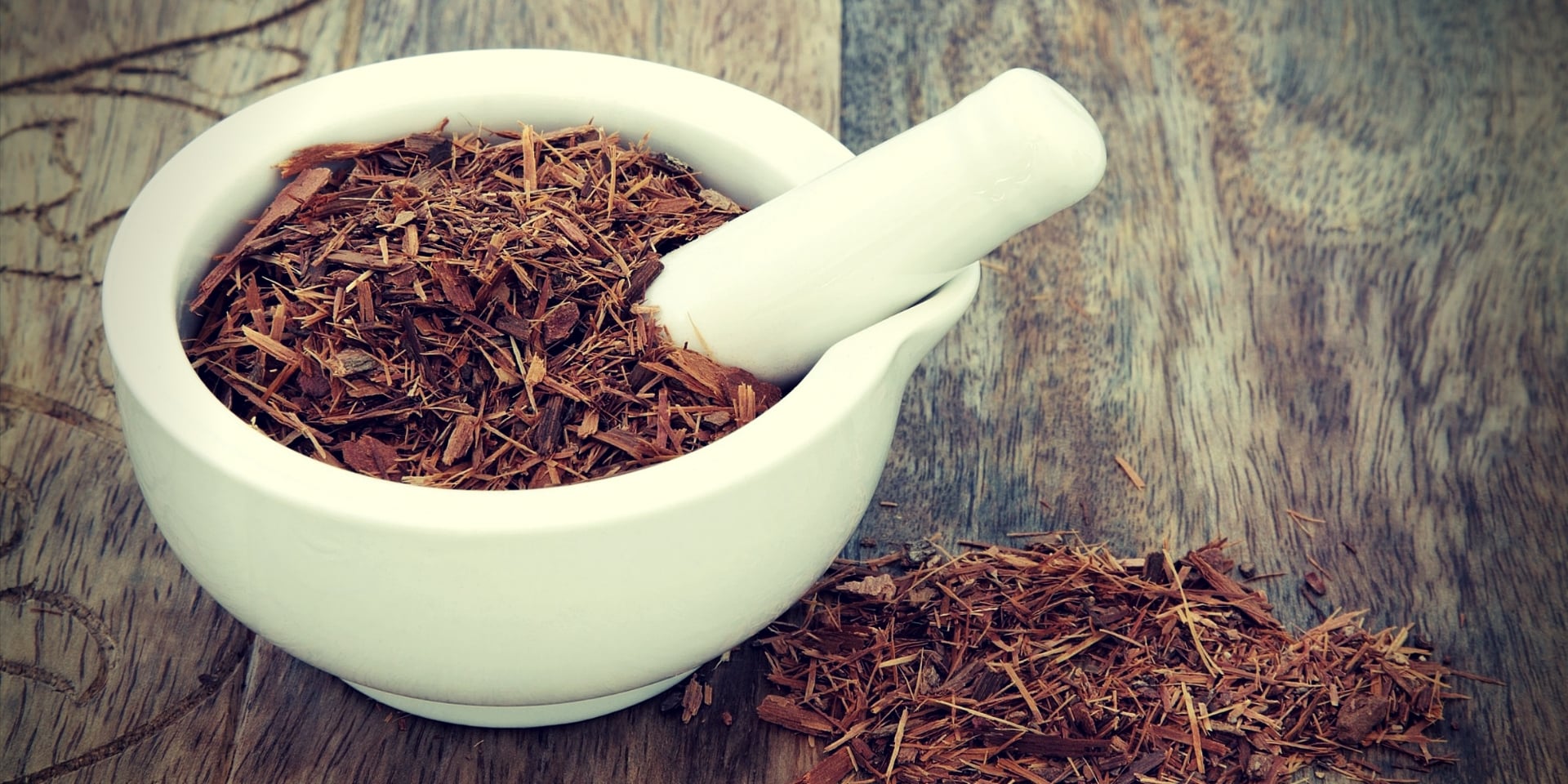
The catuaba is a fast growing tree native to the forests of the Amazon. Its bark is traditionally used as an aphrodisiac by the Tupi tribe in Brazil. Also known as trichiliacatigua, its bark is used to create an infusion. This infusion is then drunk and its effects were said to be so effective that it inspired the creation of several songs in indigenous Brazilian culture. However, we cannot just rely on cultural beliefs and traditional songs to determine its benefits. So, we did our research and here’s what we have found out about catuaba bark benefits.
Catauba Bark Benefits
- 1. Decreases the Effects of Fatigue
- 2. Protects Your Cells From Free Radical Damage
- 3. Can Slow-Down the Progression of Alzheimer’s Disease
- 4. Provides Antidepressant Effects
- 5. Alleviate Chronic Pain
- 6. Stimulates and Protects the Central Nervous System
- 7. Aids the Body in Fighting Viral Infections
- 8. Improves Blood Sugar Regulation in Type-1 Diabetes
- 9. Indirect Benefits for Your Hormonal Balance
1. Decreases the Effects of Fatigue
Your body is in a constant state of energy production, in order to meet its requirements.The amount of energy you metabolize increases in times of physically and mentally demanding activities.
You might have noticed that after long periods of physically demanding activities, there’s a significant decrease in your your physical output, which is the classic onset of fatigue.
Besides the fact that energy production does not continue in a linear fashion (it decreases over time), the cause of this muscular fatigue also relates to the accumulation of byproducts in the muscle, which impair normal contraction.
Supplementation with catuaba bark extract has been found to reduce the effects of these metabolic by-products on muscle strength. A study has shown that test subjects, who supplemented with said extract, experienced significantly less fatigue from extended aerobic activity.
2. Protects Your Cells From Free Radical Damage
The various chemical processes in the body produce natural by-products known as free radicals. If left unchecked, these can cause damage to cells, tissues, and on a larger scale organs that can contribute to development of erectile dysfunction, cancer, Alzheimer’s disease, and atherosclerosis to name a few.
Your body prevents this damage through antioxidants found in your diet and produced by the body. Catuaba bark extract contains epicatechins that have strong antioxidant effects in your body.
Two antioxidants unique to catuaba extract are catiguanin A and catiguanin B. These antioxidants have shown potential in helping fight off bacterial infections and cancer cell growth.
3. Can Slow-Down the Progression of Alzheimer’s Disease
Acetylcholine is a neurotransmitter that plays an important role in processing existing memory and learning. One of the most common biological markers ofthe progression of Alzheimer’s disease is adecrease in the amount of acetylcholine found in the brain.
This breakdown of acetylcholine can be prevented by inhibiting an enzyme by the name of cholinesterase. This is where catuaba bark extract can help. It has been observed to exhibit anticholinesterase effects similar to medications like galantamine, rivastigmine, tacrine, and donepezil.
Unfortunately, inhibiting cholinesterase is only effective when the body is still producing acetylcholine. As the disease progresses, the body would produce less and less of the neurotransmitter, and would eventually get to a point that cholinesterase inhibitors would be virtually useless.
4. Provides Antidepressant Effects
Oral consumption of catuaba bark extract has shown to induce effects similar to that of antidepressant medications. This is attributed to the extract increasing the body’s production of serotonin and dopamine, important neurotransmitters in the regulation of brain chemistry.
By increasing serotonin, your body improves its ability to regulate mood, with low levels commonly observed in persons diagnosed with clinical depression.
As for dopamine, low amounts of it lead to the inability to feel pleasure and inability to be motivated. Both of these neurotransmitters have a hand to play in the genesis of depression.
5. Alleviate Chronic Pain
From a simple headache to chronic diseases like osteoarthritis and irritable bowel syndrome which cause pain, there is some degree of inflammation involved in their development.
Catuaba bark extract can alleviate this pain by interacting with your dopaminergic system. helping your body reduce production of pro-inflammatory mediators. With decreased inflammation, the amount of pain you experience also decreases in like manner.
Its effect in alleviating pain is comparable to the analgesic effects of morphine on your central nervous system but without the risks for addiction and dependence.
6. Stimulates and Protects the Central Nervous System
The primary measure of your central nervous system’s health is how well it can change its form in response to its environment. This is known as neuroplasticity. If neuroplasticity decreases, you will experience difficulty in learning, remembering, focusing, and co-ordination.
Catauba bark extract boosts your neuroplasticity at the level of your central nervous system, thanks to its ability to stimulate dopamine and serotonin production and to promote neuronal functional recovery.
Moreover, it protects your nerves from oxidative damage by mitigating free radical damage on nerves and disease-inducing nerve degeneration.
Further studies have even shown it may be able to prevent memory loss and to help subjects recover their memory. This effect is attributed to its anti-inflammatory effects on specific brain cells.
7. Aids the Body in Fighting Viral Infections
Tests have observed trichiliacatigua bark extract’s antiviral potential on samples infected with herpes simplex virus (HSV-1), polio virus (PV-1), and bovine herpesvirus (BoHV-1).
Interestingly, non-infected samples exposed to the extract were not infected after being exposed to said viruses. This suggests that the bark’s extract has both a curative and preventive action against said viruses.
8. Improves Blood Sugar Regulation in Type-1 Diabetes
Supplementing animal test subjects with trichiliacatigua have been shown to improve markers of pancreas health in type-1 diabetes. The study has shown improvement of blood sugar regulation and inhibition of diabetic nephropathy inthe subject animals.
Despite lacking in human clinical trials, this shows a promising direction for addressing insulin production in type-1 diabetics.
9. Indirect Benefits for Your Hormonal Balance
Although it is marketed and traditionally considered an aphrodisiac, there are no studies that confirm catuaba bark is capable of directly influencing your testosterone production or sex drive. This does not necessarily mean these claims are false, just that it might simply be a case of a lack of studies on this aspect of catauba bark.
However, the good news is that the confirmed benefits of catuaba bark provide indirect benefits for your sexual health.
Catuaba bark extract’s ability to alleviate chronic pain can go a long way in improving your sleep quality. The pain that would normally wake you up in the middle of the night or prevent you from going into deep sleep would be alleviated. And, since poor sleep can negatively affect your testosterone levels, your hormonal balance is indirectly benefitting from the effects of catuaba bark.
Another way it can help is by protecting and repairing your central nervous system (CNS), which can prevent erectile dysfunction caused by nerve damage. This also includes the hypothalamus and the pituitary gland that utilize the nerves of said system for regulating production of testosterone.
Lastly, by increasing your dopamine levels, thriciliacatigua extract inhibits the secretion of the hormone prolactin in your body. Prolactin is a hormone that can lower your testosterone and libido, and promote the development of gynecomastia and erectile dysfunction.

There are still more studies to be done on the effects of catauba bark. Benefits are still waiting to be discovered and one of these could directly affect your sexual and hormonal function. Whatever the case may be, the benefits currently supported by research are already worth looking into for optimization of your overall well-being.
Where Catuaba Fits in a Male Libido Stack
Catuaba is best treated as a complementary herb that rotates with primary aphrodisiacs, not as a foundation. The cleanest practical layering:
- Foundation (strongest evidence): Tongkat Ali 200–400 mg/day for testosterone substrate. Decades of human use data.
- Direct androgen: Butea Superba for downstream signal.
- Acute PDE5 / vasodilation: Black Ginger (Kaempferia parviflora) 100–200 mg/day — documented natural PDE5 inhibitor.
- Cortisol modulation: Ashwagandha 600 mg/day KSM-66.
- Catuaba as rotation/adjunct: 1–3 g/day standardised extract for the dopaminergic and CNS-stimulant angle. Particularly relevant for men whose libido decline appears to have a low-dopamine, low-energy component.
For deeper protocols, see herbal aphrodisiacs, 40 natural aphrodisiacs for men, how to increase libido in men, male enhancement (evidence-ranked), ashwagandha and testosterone, and natural PDE5 inhibitors.
The AH Stack-Friendly SKUs
- Tongkat Ali (Eurycoma longifolia) — testosterone substrate herb with strongest male-libido data.
- Butea Superba — direct DHT and erection-quality support.
- Black Ginger (Kaempferia parviflora) — documented natural PDE5 inhibitor.
- Ashwagandha — cortisol modulation; the Wankhede 2015 T/strength data.
Frequently Asked Questions
Q: Does catuaba bark really work as an aphrodisiac?
A: Animal data and traditional use are suggestive; rigorous human RCT data is limited. The dopaminergic mechanism (in-vitro evidence catuabines act on dopamine receptors) provides plausibility, but plausibility doesn’t equal proven efficacy in humans. For evidence-based libido support, Tongkat Ali, Maca, Black Ginger, and Korean Red Ginseng have more direct human data than catuaba.
Q: How much catuaba bark per day?
A: 1–3 g of standardised extract daily, or 1–2 g of bark powder. Higher doses (above 4 g daily) produce diminishing returns and increase the risk of side effects. Take with food. Effects, if present, typically appear at 2–4 weeks of consistent dosing.
Q: Are there side effects to catuaba bark?
A: Generally well-tolerated at standard doses. Some users report mild stimulant effects (similar to caffeine), occasional GI upset, and rarely sleep disruption if taken late in the day. Concentrated extracts have potential interactions with MAOIs and other anti-anxiety medications — the alkaloid profile suggests caution combining with other psychotropic drugs. Avoid in pregnancy/breastfeeding (insufficient safety data).
Q: Catuaba vs Tongkat Ali for libido?
A: Tongkat Ali wins on evidence quality. Multiple human RCTs show measurable T elevation with Tongkat Ali in men with low-normal T; catuaba evidence is mostly animal and traditional. For libido specifically, both have anecdotal support; for measurable hormonal effect, Tongkat Ali. Many men stack both, with Tongkat Ali as foundation and catuaba as occasional rotation.
Q: Is catuaba safe long-term?
A: Limited long-term human safety data. Traditional use suggests reasonable safety at moderate doses, but rigorous long-term studies are scarce. Reasonable approach: cycle on/off (8 weeks on, 2–4 weeks off) rather than indefinite continuous use. Periodic blood work (liver function tests if using concentrated extracts long-term) is sensible. Stick to standardised products from reputable manufacturers.