
By Alex Eriksson · Medically reviewed by Ivan Kokhno, MD · Last updated May 2026
To increase dihydrotestosterone (DHT) naturally, focus on the four levers that directly drive 5α-reductase activity and androgen-receptor sensitivity: heavy resistance training (especially compound lower-body work), correcting zinc and boron deficiency, adding 5α-reductase-supportive herbs like Butea Superba and Tongkat Ali, and protecting sleep and cortisol. Most healthy men can raise DHT by 20–40 % over 8–12 weeks with these levers alone — without resorting to prohormones.
The 5-step protocol below: Heavy compound lifts (the largest single lever), zinc + boron + vitamin D micronutrient stack, Butea Superba for direct DHT support, creatine for the documented 40–56% DHT bump, and 7+ hours of sleep. Realistic timeline: 8–12 weeks for measurable change.
What Is DHT and Why Increase It?
Dihydrotestosterone (DHT) is the most potent androgen in the human body — about three times more powerful at the androgen receptor than testosterone itself. It’s produced when the enzyme 5α-reductase converts testosterone into DHT, primarily in the prostate, skin, scalp, liver and central nervous system.
While DHT has been demonised because of its role in male-pattern hair loss and prostate enlargement, the same hormone is responsible for adult male sexual development, libido, erectile firmness, drive, aggression, lean muscle quality and the “feeling” of being male. Men with low DHT — not just low testosterone — report flat libido, soft erections, low motivation, depression and reduced gym output even when total testosterone looks normal on paper.
If your symptoms are libido- and drive-related rather than fatigue- and recovery-related, low DHT (not low testosterone) is often the missing piece — and it’s addressable without prescription drugs.
The DHT Pathway in 60 Seconds
Three things must be true for your body to produce healthy DHT levels:
- Enough testosterone substrate. DHT is made from testosterone. If total or free testosterone is low, DHT will be low downstream regardless of how active your 5α-reductase is.
- Sufficient 5α-reductase activity. The enzyme exists in two main isoforms (Type 1 in skin/scalp/liver, Type 2 in prostate/genital tissue). Both are influenced by diet, training stimulus, micronutrient status and certain herbs.
- No active 5α-reductase inhibitors. Finasteride and dutasteride are the obvious blockers, but lesser-known dietary inhibitors (saw palmetto, pumpkin seed oil, green tea EGCG in high doses, soy isoflavones, reishi mushroom) suppress conversion if consumed regularly.
The strategies below address all three nodes.
5-Alpha-Reductase: The Enzyme That Controls Your DHT Output
The single enzyme that determines how much testosterone becomes DHT is 5-alpha-reductase (sometimes written 5α-reductase or 5-AR). It exists in two main isoforms: type 1 is concentrated in skin, scalp, and liver; type 2 dominates in the prostate, testes, and seminal vesicles. Both convert testosterone into DHT by reducing the 4,5 double-bond on the testosterone backbone — a small chemical change that produces a large pharmacological one. DHT binds the androgen receptor with about 5× the affinity of testosterone, which is why even a modest rise in 5-alpha-reductase activity translates into a meaningful upgrade in androgen signal at the tissue level.
Most of the natural levers covered in this guide work by influencing 5-alpha-reductase activity OR the substrate (free testosterone) it has to work with. Resistance training, creatine, sorghum, and zinc each upregulate enzyme activity directly. Boron lowers SHBG so more testosterone is biologically available for conversion. Butea Superba and Tongkat Ali both raise the substrate (testosterone) AND have mild positive effects on conversion enzyme expression. None of this is about overriding hormone production from the gonads — it’s about optimising the downstream metabolism and conversion of the testosterone you’re already producing. That distinction matters: a man with low total testosterone can’t compensate by maximising 5-alpha-reductase activity; the upstream hormone production capacity sets the ceiling.
If your testosterone is already in the upper half of the reference range and you want more DHT-driven libido, energy, and tissue effect, the natural levers below work. If your testosterone is below 400 ng/dL, fix that first — bloodwork, lifestyle audit, possibly TRT — and DHT will follow naturally because the substrate is finally there.
The 5 Most Effective Ways to Increase DHT Naturally
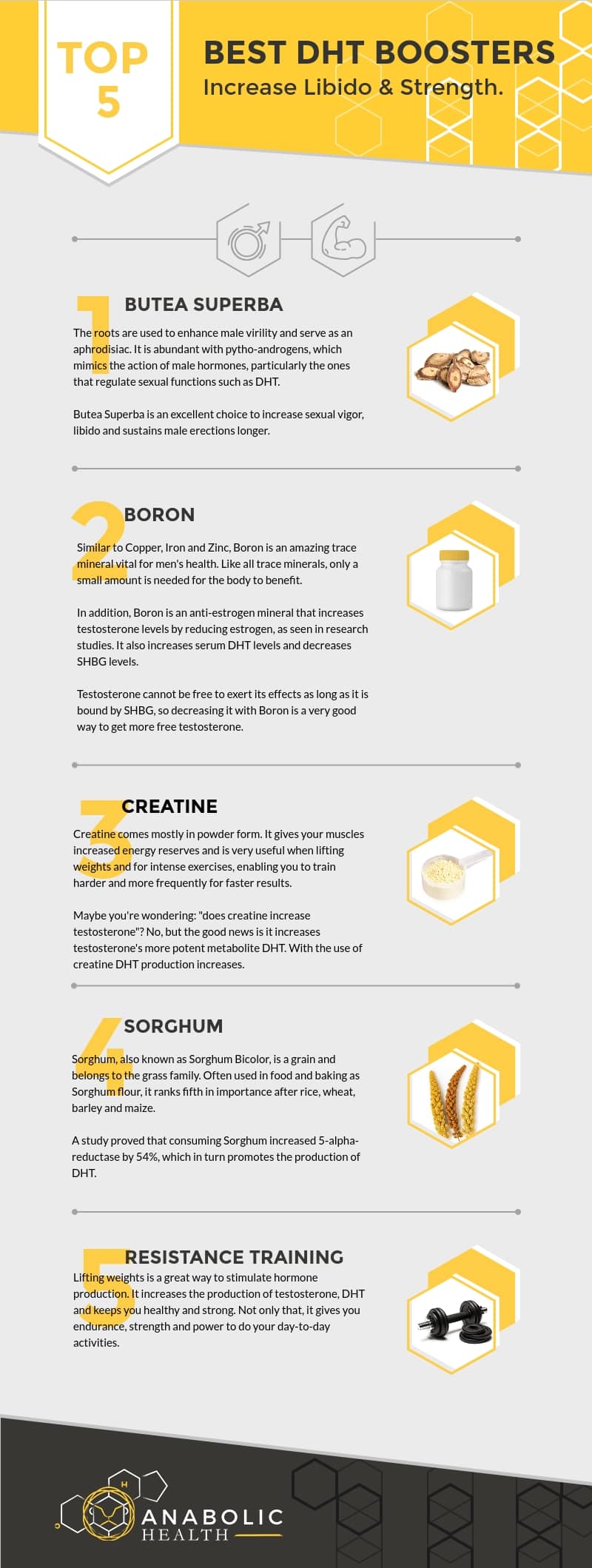
1. Heavy Compound Resistance Training
Heavy lower-body compounds — squats, deadlifts, leg press — produce the largest acute DHT response of any non-pharmacological intervention. The mechanism is twofold: the work itself elevates serum testosterone (the substrate), and the muscle damage and growth-hormone surge trigger upregulation of 5α-reductase Type 1 in muscle tissue.
Protocol: 3–4 sessions per week, hitting at least one major compound (squat, deadlift, bench press, military press, weighted pull-up) per session at 70–85 % of 1RM for 4–6 sets of 4–8 reps. The DHT response is dose-responsive to load and total volume; cardio and high-rep isolation work do not produce the same effect.
2. Correct Zinc and Boron Deficiency
Both zinc and boron are essential cofactors in androgen pathways. Zinc deficiency directly suppresses both testosterone production and 5α-reductase activity — correcting a deficiency raises DHT measurably within 4–6 weeks. Boron reduces sex-hormone binding globulin (SHBG), freeing up more bioavailable testosterone for conversion to DHT, and has been shown to elevate free testosterone within 7 days at 10 mg/day.
Protocol: 25–30 mg zinc picolinate or zinc bisglycinate before bed (away from coffee and dairy), and 6–10 mg boron with breakfast. If you’ve been using zinc for 3+ months, add 1–2 mg copper to prevent imbalance.
3. Butea Superba (Red Kwao Krua)
Of all the herbs traditionally used to boost male hormones, Butea Superba has the most direct DHT-elevating effect in published clinical research. The active compounds are flavonoid glycosides that appear to upregulate androgen-receptor expression and support 5α-reductase activity rather than suppress it (unlike most other “testosterone” herbs).
Thai studies on aging men showed measurable improvements in erectile function and libido at 250–500 mg/day of standardised root extract over 8–12 weeks.
Protocol: 250–500 mg standardised Butea Superba extract once daily with food. Cycle 8 weeks on, 2 weeks off.
4. Creatine Monohydrate
Creatine’s effect on DHT was a surprise finding from a 2009 South African rugby study: 7 days of high-dose creatine loading (25 g/day) followed by 14 days at 5 g/day raised serum DHT by 56 % during loading and held it 40 % above baseline at maintenance. The proposed mechanism is direct support of 5α-reductase via cellular phosphocreatine availability in tissues that express the enzyme.
Protocol: 5 g/day of creatine monohydrate. Skip the loading phase — daily 5 g produces the same outcome over a few weeks, with no cramping or water-retention complaints.
5. Sleep, Stress and Cortisol Discipline
Cortisol and DHT have an inverse relationship that few protocols address. Chronic stress and sleep deprivation suppress LH, reduce testosterone substrate, and downregulate 5α-reductase. Men who report low libido despite “normal” testosterone almost always have either elevated evening cortisol or fewer than 7 hours of consolidated sleep.
Protocol: 7+ hours of sleep with consistent timing, daylight exposure within 30 minutes of waking, no caffeine after 14:00, and an adaptogen like Ashwagandha (300 mg KSM-66 twice daily) for 8–12 weeks if cortisol is the limiting factor.
Other Supplements That Support DHT
Beyond the core five, a handful of secondary supplements support the same pathways:
- Tongkat Ali (Eurycoma longifolia): raises free testosterone and reduces SHBG; indirectly supports DHT. 200–400 mg standardised extract per day.
- Ashwagandha: the cortisol-management piece — chronic stress is one of the biggest DHT suppressors, and KSM-66 ashwagandha at 300 mg twice daily lowers evening cortisol measurably within 4 weeks.
- Vitamin D-K-A-E multivitamin: deficiency in any of these supresses testosterone substrate; supplement to a serum 25(OH)D level of 40–60 ng/mL.
- Forskolin: activates cAMP signalling in Leydig cells; modest substrate effect. 250 mg of 10 % Coleus forskohlii twice daily.
- Caffeine (acute): modestly elevates testosterone and DHT pre-workout; contributes to chronic cortisol problems if abused. 100–200 mg pre-training only.
- L-arginine + L-citrulline: not direct DHT boosters, but improve the downstream effects (erectile firmness, vasodilation) that DHT drives.

Foods That Support and Block DHT
Diet is a smaller lever than training and supplementation but worth getting right. The pattern is high-quality animal protein, sufficient saturated fat (testosterone substrate), and avoidance of known 5α-reductase inhibitors.
Foods that support DHT: pasture-raised eggs, grass-fed beef, oysters and shellfish (zinc), organ meats (cholesterol substrate, retinol), pomegranate (small DHT-elevating effect in studies), olive oil (oleic acid supports steroidogenesis), and Brazil nuts (selenium for testosterone).
Foods that block DHT (eat sparingly if your goal is to raise DHT): green tea above 4 cups/day (high-dose EGCG inhibits 5α-reductase), saw palmetto in any supplement form, pumpkin seed oil, soy and unfermented soy products, reishi and maitake mushrooms above culinary doses, flaxseed (lignans).
For the broader food list, see our testosterone-boosting foods guide — the same dietary pattern that supports testosterone supports DHT.
What to Avoid
Increasing DHT means actively avoiding the things that suppress it:
- Finasteride and dutasteride — obvious; these are 5α-reductase inhibitors prescribed precisely to lower DHT. If you’re on either drug for hair loss or BPH, talk to your doctor before stopping.
- Daily saw palmetto — common in many men’s health supplements; check labels.
- High-dose green tea extract — one cup is fine; 800 mg+ EGCG concentrate is not if your goal is DHT.
- Endocrine disruptors — BPA from receipts and plastic, parabens in personal care, phthalates in soft plastics. The chronic exposure adds up.
- Chronic alcohol — depresses LH and 5α-reductase activity. Occasional drinking is fine; nightly is not.
- Chronic cardio without recovery — long-distance endurance work raises cortisol and suppresses androgens over months.
Who Should Be Cautious About Raising DHT
DHT is a powerful androgen and not the right target for everyone:
- Men with active male-pattern baldness — raising DHT will accelerate hair loss in genetically susceptible men. If your hair matters more than the libido and gym effects, stop here.
- Men over 50 with prostate symptoms — baseline PSA testing and a discussion with your doctor before pushing DHT up.
- Anyone with diagnosed BPH — raising DHT will worsen symptoms.
- Women — DHT drives female-pattern hair loss, hirsutism, voice deepening and acne, and these effects are mostly irreversible.
How Long Until You See Results
The realistic timeline for natural DHT optimisation is:
- Week 1–2: if you correct a zinc or boron deficiency or start a creatine load, libido and morning erections often improve first.
- Week 3–6: training-driven DHT elevation becomes measurable; gym output and motivation improve.
- Week 8–12: herbal interventions (Butea Superba, Tongkat Ali, Ashwagandha) reach steady-state effect; full body-composition and drive improvements become visible.
- Beyond 12 weeks: diminishing returns from the same protocol — cycle herbs, swap one supplement for another, or accept the new baseline.
If 12 weeks of consistent training, sleep and the supplements above produce no change — and bloodwork confirms low DHT — that’s when prohormone or pharmaceutical conversation makes sense with a clinician.
Frequently Asked Questions
Q: How can I increase DHT quickly?
A: The fastest measurable shift comes from heavy lower-body resistance training plus correcting zinc and boron deficiency — both can lift DHT within two weeks. Creatine loading (25 g/day for 7 days) produces the largest published acute DHT increase (+56 % in one study) but the effect normalises to a sustainable +40 % on maintenance dosing.
Q: What supplements increase DHT the most?
A: In rough order of evidence and effect size: creatine monohydrate (5 g/day), Butea Superba (250–500 mg standardised), zinc (25–30 mg), boron (6–10 mg), and Tongkat Ali (200–400 mg). Stacking three or four at a time is more effective than rotating.
Q: How do I increase 5-alpha reductase?
A: 5α-reductase activity is increased by heavy resistance training, adequate zinc, sufficient cholesterol-containing foods (eggs, beef, organ meats), creatine, and avoiding the dietary inhibitors listed above. There is no direct supplement that “activates” the enzyme — the lever is removing what suppresses it and providing the cofactors it needs.
Q: Can I increase DHT without increasing testosterone?
A: Not really — DHT is made from testosterone, so raising one tends to raise the other. The closest you can get is creatine, which produces a disproportionate DHT response relative to its small testosterone effect. Conversely, if you want to raise testosterone without increasing DHT, you’d use saw palmetto or finasteride alongside the testosterone-raising work — but that’s the opposite of this article’s goal.
Q: Will raising DHT cause hair loss?
A: Only if you have the genetic predisposition. Men whose male relatives kept their hair into old age can raise DHT considerably without losing scalp hair. Men with a family history of male-pattern baldness will accelerate the process by elevating DHT — this is the single most important trade-off to understand before pursuing this protocol.
Bottom Line
Increasing DHT naturally is straightforward and predictable for most healthy men: train heavy, sleep enough, correct zinc and boron deficiency, add creatine and a single 5α-reductase-supportive herb like Butea Superba, and avoid the pharmaceutical and dietary inhibitors that quietly suppress conversion. The full protocol takes 8–12 weeks to reach steady state and tends to produce noticeable improvements in libido, drive, gym output and erectile firmness within the first 4–6.
For the underlying picture, see our guide to testosterone-boosting foods and testosterone-boosting herbs. To understand the prohormone alternative, see our review of epiandrosterone — the over-the-counter compound that converts directly to DHT.