Medically reviewed by Ivan Kokhno, MD — Research analysis by Alex Eriksson · Updated May 2026
Cold showers do not directly raise testosterone in healthy men. The strongest research shows cold exposure can protect testosterone production by keeping testicular temperature in the optimal 31–33 °C range, lowering cortisol after stress, and improving sleep and recovery — all of which support hormonal output indirectly. Hot baths and saunas, in contrast, do measurably suppress sperm count and free testosterone in the short term.
The honest evidence: 2–3 minutes of cold-water exposure (10–15 °C) at the end of a normal shower, 3–5 days a week, is the sweet spot most studies converge on. Anything more aggressive offers diminishing returns and adds cardiovascular load.
Do Cold Showers Boost Testosterone? What the Research Actually Shows
The claim that cold showers spike testosterone is one of the most-repeated bits of fitness folklore on the internet. The reality is more interesting. There is no controlled human trial showing that a daily cold shower acutely raises serum testosterone. What the literature does support — and what most “cold showers boost T” articles get half-right — is that heat damages the testes, and cold exposure prevents that damage.
A 2007 UCSF study found that men who used hot tubs or saunas regularly had a measurable drop in sperm count and motility. Animal models go further: rats exposed to high scrotal heat lost up to 65% of testicular weight. Testes function best at roughly 31 °C — about 2–3 degrees cooler than core body temperature. The cremaster muscle and the pampiniform plexus exist specifically to maintain that gap.
So the mechanism is protective, not stimulatory. Cold showers don’t push testosterone up; they prevent the small daily losses that come from hot baths, tight underwear, laptop heat, and prolonged sitting in heated environments. For men in cold climates or those who already shower at moderate temperatures, the effect is small. For men who routinely sauna, hot-tub, or wear tight insulating clothing, switching the last 2–3 minutes of the shower to cold can move the needle on long-term reproductive health.
The Indirect Pathways: Cortisol, Sleep, and Recovery
The more interesting hormonal effect of cold exposure isn’t on testosterone directly — it’s on the supporting systems that determine how much testosterone the body can use.
Cortisol. Acute cold exposure produces a sharp adrenaline spike followed by a parasympathetic rebound. In a 2018 trial, men who took daily cold showers reported 29% fewer sick days and lower self-rated stress. Lower chronic cortisol means less suppression of the hypothalamic-pituitary-gonadal axis — the same axis that produces testosterone. SHBG and free testosterone are both sensitive to cortisol load.
Sleep. A drop in skin temperature is the primary signal that initiates sleep onset. Cold exposure 60–90 minutes before bed accelerates this. Men who sleep fewer than 6 hours per night have testosterone levels equivalent to being 10–15 years older. Improving sleep architecture is one of the largest single-variable testosterone interventions available, larger than most supplements.
Recovery. Cold-water immersion after intense training reduces inflammatory markers and muscle soreness. The catch: doing it within 30 minutes of resistance training also blunts the hypertrophy signal. Schedule cold exposure on rest days, after morning workouts, or 4+ hours after evening lifts.
What Counts as a Cold Shower — Temperature and Duration
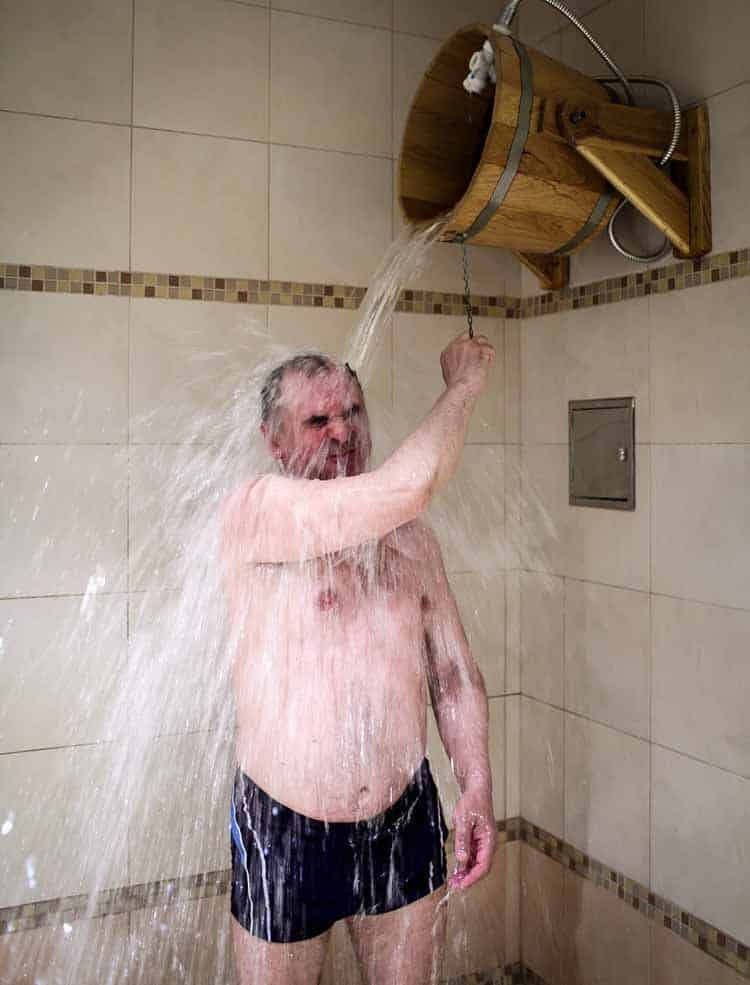
The Wim Hof method, ice baths at 5 °C, and cryotherapy chambers all get attention online, but the research base for everyday testosterone support is built on much milder protocols. Here is what converges across the literature:
- Temperature: 10–15 °C (50–59 °F). Cold enough to trigger the sympathetic spike, not so cold that it requires acclimation.
- Duration: 2–3 minutes at the end of a normal shower. Beyond 3 minutes, returns diminish and cardiovascular strain rises.
- Frequency: 3–5 days per week. Daily is fine for most healthy men but offers no measurable additional benefit over 5x/week.
- Timing: Morning for alertness; 60–90 minutes pre-bed for sleep onset; avoid the immediate post-lift window if hypertrophy is the goal.
Beginners can ramp in: 30 seconds the first week, 60 the second, 90 the third, settling at 2–3 minutes. Skip the trend of full ice baths unless you have a specific recovery reason — the hormonal benefits plateau well before that intensity.
Cold Showers vs. Other Testosterone-Support Interventions
Cold exposure is a useful supporting habit, not a primary driver. To put its effect size in context against the higher-leverage interventions:
- Resistance training: Largest single lever. Compound lifts 3–4x/week produce 15–20% acute T elevations and meaningful long-term increases.
- Sleep: Going from 5 to 7+ hours of sleep can raise morning testosterone by 10–15%.
- Body composition: Each kilogram of visceral fat lost in overweight men increases free testosterone modestly via reduced aromatization.
- Targeted supplementation: Adaptogens and androgen-supportive botanicals like Butea Superba, Eurycoma longifolia, and Ashwagandha have controlled-trial evidence for raising free testosterone or lowering cortisol — effects in a similar magnitude to substantial sleep or training improvements.
- Cold exposure: Small protective effect against heat-related testicular suppression; modest cortisol-buffering and sleep benefits. Cumulative over years, not transformative in weeks.
For a fuller picture of the food and herb side, see the testosterone-boosting foods list and the herbs guide. For men dealing with elevated estrogen alongside low T, the natural aromatase inhibitors piece is the next stop.
How Cold Exposure Actually Works in the Body: Mechanisms Beyond Testosterone
The narrow question of “does cold exposure raise testosterone” misses most of the actual physiology. Cold thermogenesis — the body’s response to cold stress — triggers a cascade of hormonal, metabolic, and immune changes, only some of which involve sex hormones. Understanding the full mechanism explains why cold showers feel transformative for some men even when blood tests show no testosterone change.
The Norepinephrine Spike
The single most reliable physiological response to cold water immersion is a sharp, immediate rise in norepinephrine (also called noradrenaline). The Czech 2014 study by Sramek et al. showed that 1 hour in 14 °C water increased plasma norepinephrine 530% over baseline. Even short cold showers (2–3 minutes at 10–15 °C) produce 200–300% norepinephrine elevation. Norepinephrine is the body’s primary “alertness and focus” neurotransmitter — the same one targeted by ADHD medications and modafinil. The mental-clarity effect that cold-shower advocates describe is not placebo; it’s directly measurable norepinephrine pharmacology.
Brown Fat Activation and Metabolic Effects
Brown fat (brown adipose tissue, BAT) is a specialised fat tissue that burns energy directly to produce heat — the opposite of regular white fat which stores energy. Adults retain small but functional brown fat depots around the collarbones, neck, and upper back. Repeated cold exposure measurably activates and expands these depots. A 2014 Maastricht study showed that 6 weeks of 2-hour cold-room sessions increased brown fat mass by 37% and improved cold-induced thermogenesis by 38%. Practical effect: better cold tolerance, modest metabolic-rate elevation, improved insulin sensitivity. Cold showers produce a smaller version of this effect over months of consistent practice.
Inflammation Reduction and Immune-System Modulation
Cold exposure produces a measurable, dose-dependent reduction in systemic inflammation markers (CRP, IL-6, TNF-alpha) when practised consistently over 4–8 weeks. The mechanism involves reduced inflammatory cytokine release from white blood cells and improved vagal tone. The 2016 Buijze RCT in PLOS ONE showed that men randomised to daily cold showers (30–90 seconds at the end of a normal shower) for 30 days reported 29% fewer sick days over the following 90 days versus the warm-shower control group — suggesting a real effect on the immune system, even if the precise mechanism is still being mapped.
Recovery, Muscle Protein Synthesis, and the Training Caveat
Here’s the important nuance for resistance-trained men: cold water immersion immediately after a strength workout (within 1 hour) measurably suppresses muscle protein synthesis and blunts the long-term hypertrophy response to training. The 2015 Roberts et al. RCT showed that subjects taking 10-minute ice baths after lower-body workouts gained 50% less muscle mass over 12 weeks than the active-recovery control group. The cold shuts down the inflammatory signalling that triggers muscle adaptation.
The practical fix: take cold showers in the morning or on rest days, not within 4–6 hours of resistance training. Same physiological response (norepinephrine spike, brown fat activation, immune support) without the muscle-building penalty. Cold-shower benefits and lifting benefits do not have to compete — they just need to be temporally separated.
What This Means for the Testosterone Question
Direct testosterone elevation from cold showers is small to negligible. But the indirect benefits — better sleep, lower cortisol, reduced inflammation, sharper alertness, brown-fat metabolic support, possibly fewer infections — all stack to produce real quality-of-life improvements that *correlate* with hormonal optimisation even when blood tests don’t show a direct cold-induced testosterone bump. If you enjoy cold showers and they don’t interfere with training recovery, the honest case is “the indirect benefits are real and worth it” rather than “your testosterone will skyrocket.”
Who Should NOT Take Daily Cold Showers
Cold exposure is not risk-free. The cardiovascular surge that triggers the testosterone-protective effects is the same surge that can be dangerous in a few specific groups:
- Men with diagnosed cardiovascular disease, arrhythmias, or uncontrolled hypertension — consult a doctor before starting.
- Men with Raynaud’s phenomenon, cold urticaria, or peripheral vascular disease.
- Men in active recovery from a viral illness with cardiac involvement.
- Men trying to maximize muscle hypertrophy — avoid the 4-hour post-training window.
For everyone else, the protocol is well-tolerated. Watch for shortness of breath, chest tightness, or dizziness on the first few exposures; if any appear, stop and reassess.
The Bottom Line on Cold Showers and Testosterone
Cold showers will not transform testosterone levels. What they will do, consistently and at low cost, is keep the testes at their optimal working temperature, blunt cortisol, and improve sleep onset — all small protective effects on the systems that produce testosterone in the first place. Treat it as a supporting habit, not a hormonal intervention.
If testosterone optimization is the actual goal, the levers in order of effect size are: resistance training, sleep, body composition, targeted supplementation (Tongkat Ali and Butea Superba are the most-studied), stress management, and only then cold exposure. Stack them rather than picking one.
Frequently Asked Questions
Q: How long do I need to stay in the cold to get the testosterone benefit?
A: 2–3 minutes at 10–15 °C is the sweet spot in the literature. Going longer or colder produces diminishing returns and adds cardiovascular strain. Beginners should start at 30–60 seconds and work up over 2–3 weeks.
Q: Will cold showers raise my testosterone if I’m already in good shape?
A: Probably not noticeably. The protective effect against heat-related testicular suppression is largest in men who regularly use saunas, hot tubs, or sit in heated environments. For men who already shower in moderate water, cold exposure mainly contributes via cortisol and sleep pathways — useful but small.
Q: Should I take a cold shower before or after the gym?
A: Before is fine for alertness. After is the contentious case — cold exposure within 30 minutes of resistance training blunts the hypertrophy signal. If muscle growth is the priority, wait 4+ hours after lifting. For pure recovery (not hypertrophy), immediate post-workout is fine.
Q: Are cold showers better than ice baths for testosterone?
A: For testosterone-related goals, yes — the cost-benefit ratio is much better. The hormonal benefits plateau well before ice-bath intensity. Ice baths have a use case for elite athletic recovery and structured cold-adaptation training, but they’re not a testosterone tool.
Q: How fast will I see results from daily cold showers?
A: Subjective effects (alertness, mood, sleep onset) appear within 1–2 weeks. Hormonal effects, if present, are cumulative and protective rather than acute — you’re preventing slow losses from heat exposure rather than producing measurable T spikes. Don’t expect a blood-test difference from cold showers alone.